When Playwright Jeremy O. Harris Met Artist Jordan Wolfson - Vulture
When Playwright Jeremy O. Harris Met Artist Jordan Wolfson - Vulture |
- When Playwright Jeremy O. Harris Met Artist Jordan Wolfson - Vulture
- Transparent Goes Out With One Last Crazy Dance - Vulture
- There’s a free screening of ‘Aquaman’ at a Macon park – and free popcorn! - Macon Telegraph
- ‘Snake Eyes': Ursula Corbero to Play Baroness in ‘GI Joe’ Movie Spinoff (Exclusive) - TheWrap
| When Playwright Jeremy O. Harris Met Artist Jordan Wolfson - Vulture Posted: 27 Sep 2019 09:58 AM PDT  Photo: Alex Casto. Courtesy David Zwirner. This week, the second season of David Zwirner's podcast, Dialogues, premiered with a conversation between two provocateurs: the playwright, and budding fashion icon, Jeremy O. Harris, and the artist Jordan Wolfson. Hosted by Zwirner's son, Lucas Zwirner, the conversation is an estimable pairing of controversialists. Harris's Slave Play, a confrontational presentation of sex and plantation politics that was once a thesis project, is currently on Broadway. Wolfson is a Zwirner-signed artist most famous for his lurid animatronic sculptures. At the Whitney's 2017 biennial, his virtual-reality film Real Violence gave viewers an immersive taste of homicidal street rage. The venn diagram of interests between the pair would include a general preference for, let's say, unlikely transgressive subjects, like Pornhub's geographic data, being "queer for clout," emotional biohacking, and the sexual erotics embedded in the 1980 comedy Trading Places. Porn is a portal…to the world? Jeremy O.Harris: I love watching porn for just like what's happening in the world. Like, what are people into? I love looking at the most popular videos in different regions. Going to Pornhub in Berlin compared to going to Pornhub in London is so radical. Pornhub in Berlin is a lot more violent, just naturally and casually violent. There's this weird French style of gay porn that — It's all these Middle Eastern men with huge dicks, just finding guys that are just wandering around the city, and then they just beat up these guys — Wolfson: They beat them up? Harris: Yes, and then, they fuck them. Wolfson: Oh, we don't have that. We don't have that with girls. We don't beat them up. Harris: You don't know what you're missing. Sorry, dark! I think it also has to do with the fact that there's this deep eroticized fear of the Middle East in all of Europe, especially mainland Europe. But I think that they've made an object of that fear, an object that they can fuck and an object that can validate that fear but also validates the erotic. Representation: the ultimate"bio-hack" Wolfson: The gallery is a stage that the viewer gets to walk on to. And I thought about that when I was in Daddy. Here is this contrived event, completely contrived, fabricated event. We're watching it. There's a pool and a house, and we all believe it. We're all in it. I said, "Isn't that fabulous?" We can have that part of our human experience, that we can get hacked by narrative, hacked by form. I think that's an amazing part of the human experience, this idea of representation. How we are hacked by representation is really compelling. Harris: It's wild. I had this thing, where I was like, "Representation doesn't matter." I hated people telling me that I had to like something just because there were black people in it. I feel more represented than I am loved in a weird way. I am Tilda Swinton eating the prawn. But then, I saw the Spider-Man movie, and I was literally hacked by that movie. [Laughs] And I was like, representation does matter! I didn't even want to admit it at the time. The teenage erotics of the 1980s Dan Aykroyd comedy, Trading Places: Wolfson: My go-to porn as a kid was Trading Places, the movie with Dan Aykroyd and Eddie Murphy. There is a scene with Jamie Lee Curtis, who plays a prostitute. There's this part where she changes in front of Dan Aykroyd. She gets naked and changes in front of him. And that was the most titillating thing for me and I watched it, and I would show it to all my other friends and it was sacred. Harris: The film that unlocked my erotics was The Dreamers, which I think is a lot of people's movie. Louis Garrel in that movie was the sexiest thing to me. There's a scene where they're talking about Maoism at [Jean-Luc Godard's] La Chinoise. There's a huge Mao poster and Louis Garrel and Michael Pitt are in these silk house robes. At one point Garrel grabs Pitt's throat, and then slowly slides over and he puts one leg over his leg and his crotch is touching his butt. I would rewind that over and over and over again. It was so hot, but it always sucks because Eva Green comes in, and she's like, "Boys, what are you doing?" And I'm like, "God damn it. Why did she come in and ruin that?" A story involving the actor Michael Pitt, rat poison, and a sushi dinner: Wolfson: Whenever I hear about Mike Pitt, I just remember this weird traumatizing night with this middle-aged man who was peeing on himself. It was back when I was 19 or 20. We'd hang out at the house of this 65-year-old guy named Joe Smith. We'd go there and smoke pot in his loft on 20th street. Everything was maroon and all the windows were covered. There'd be all of these young gay dudes messing around with Joe. He was really cool and once he lent me money to buy a video camera. But there was one kid that Joe had a relationship with who had begun to slip him rat poison to get more money from him. One night me and Mike Pitt had to take care of him. One night I called Mike to see what he was doing, and he's like, "I'm at Joe's house; he's dying." So, I had this super-awkward night eating sushi with Mike Pitt over there. I remember stuffing money into this dying man's pocket. I'm like, "Joe, I'm paying you back for this camera." On being "gay-adjacent" but not, of course, for clout Harris: Whenever I talk about you, people are like, "He's not gay, right? He feels gay." And I'm always like, "I don't know." Wolfson: I am a little actually gay. Harris: What is a little actually gay? Because everyone's queer for clout now. Wolfson: I wouldn't say it's queer for clout. I have hooked up with guys. I have five good guys. But for the most part, I date women. I really, really love women in a way that I haven't had access to men at this point. I'm open but women — Harris: But gay adjacent. Wolfson: Yeah, I would say so. The struggles of working in an industry dominated by baby boomers: Harris: It's fucking annoying. I mean, I'm really interested in being in a conversation with a 60 year old about my play, or an 80 year old about my play. But working in the theater, the thing that sucks is that baby boomers run the theater, not just in the audiences, but behind the scenes. And every other industry, I think the baby boomers are trying to actively kill us by just not being like, "Okay, maybe let some new ideas come in." On the very safe, virtue signaling response of critics to HBO's Euphoria: Harris: I've been watching all the critics tiptoe around what their actual opinion is of the show, inside of the review. They were all giving non- reviews because I think they're waiting to see what the internet's going to say before they either championed it or not. They had the virtue signal. They were like, "Guys I don't know if kids can take this." It's really scary. I'm like, "Were you never a teenager?" Do you not remember all the dark shit you imagined, and all the dark shit you did, and all the dark shit and you hope to do? These kids are going to eat this up and then start glamorizing it. They're going to be excited that someone's representing part of their psyche — in some way, shape, or form. We're in this moment now where people are afraid to even make tepid steps toward transgression because there's so much fear that some phantom trouble will come following you. Wolfson: There's so much fear. Everyone is holding onto the seat and the table at the same time. I always felt that transgression lead to transformation. Go to any young hero story. There's this point where the hero goes through a sort of transgressive situation to come out renewed, and that's the viewer. In a way, we're giving that to them, be it in the gallery or in the theater.  |
| Transparent Goes Out With One Last Crazy Dance - Vulture Posted: 27 Sep 2019 09:17 AM PDT  Photo: Jessica Brooks / Amazon "Let's have one of the most memorable days of our artistic lives!" Standing in Griffith Park among a grove of cedars overlooking Los Angeles, Transparent creator Jill Soloway bellows a kind of invocation to a crowd of approximately 150 people, more than half of whom are dressed in Technicolor costumes. The cast and crew are here on this chilly January morning, along with several busloads of dancers and extras, to help Soloway bring the series to an end with a movie-musical-style finale: an all-hands-on-deck song-and-dance number called "Joyocaust." "Breathe in the knowledge that you're in the exact right place," Soloway continues, as heads bow all around them. "There's no right or wrong, no getting in trouble. Channel the feeling of utter joy onto your face and body because that's what this is—a dream of a future world that we're living in today." "If we could also take a moment to acknowledge that this land belonged to people before we were here," producer and co-star Shakina Nayfack adds, "and to ask for permission from the spirits to honor them in this thing we're creating." The chorus of cheers is so loud a crew member must deliver one final order of business via megaphone: "There is an imminent threat of poison oak! Please don't be reaching out and touching anything." In some ways, it seems like any other day on a Transparent set. Ever since the Amazon series premiered in 2014, Soloway has tried to create an environment that would allow the cast to feel comfortable with the intimacy expected of them. "We don't talk about it a lot, but Transparent was a hard show to do," says co-star Jay Duplass, who plays the feckless Josh Pfefferman. "From crazy sex scenes to baring your soul—it's very rigorous." This morning's benediction is an abbreviated version of a long-standing tradition the showrunner calls "box," in which everybody is invited to share experiences from their daily lives. "Vulnerability works like glue," says Soloway, who came out as gender nonbinary in 2016 (they prefer the third-person pronoun). "That kind of connection makes the day go faster." That circle of trust was broken last year when the show's star, Jeffrey Tambor, was fired after being accused of sexual harassment by two of his trans colleagues—his former assistant Van Barnes and his co-star Trace Lysette. For four seasons, Tambor anchored Transparent as Maura Pfefferman, a father who comes out as transgender and inspires her family members to examine their own uneasy identities. Though there was skepticism from the start about casting a cis man in the role, the show was widely embraced by critics as groundbreaking. It won eight Emmys. Two of them were for Tambor's performance. Now Soloway had no choice but to kill off the series' protagonist, along with the series, and they had decided to do so in a movie-musical finale. "Everything burned to the ground," Soloway says simply. The act of staging a musical quickly became part of the healing process. "The whole thing is so meta," Soloway muses. "Joyocaust" in particular is about finding new ways to cope with pain. It is the series' fait accompli, a powerful, exuberantly orchestrated ensemble piece in which pleasure is presented as a form of resistance to living in terrorized spaces. The song also closes in on perhaps the show's greatest legacy. Over the years, as Transparent interrogated gender identity and challenged taboos, the horror of the Holocaust remained in its DNA; the idea of inherited trauma was often presented as inseparable from the characters' suffering. Previous seasons flashed back to Nazi Germany and sent the Pfefferman family on a fraught trip to Israel. Soloway wonders if "the whole reason we did the show was so we could do 'Joyocaust.'" Indeed, it might seem almost too on-the-nose that Transparent would end this way, with an over-the-top reverie about the Holocaust, complete with Munchkin-worthy costumes. In the movie, the song follows the shiva for Maura. Mourners pass through a portal, which is actually just a hole in a chain-link fence behind the Pfefferman home, to rejoice with loved ones in a radical queer paradise. Their mournful black attire abruptly transforms into a rainbow of outfits. Maura's ex-wife, Shelly—Judith Light, clad in a lemon-yellow tuxedo—leads the procession with Barnum & Bailey bravado, singing, "Take the concentration out of camps / And concentrate it on some song and dance." It's Peak Transparent—earnest, absurdist, with a wink of self-awareness. But it's also an ending that could only make sense post-Tambor. The lyrics look forward, offering a promise for moving through the #MeToo era. "This time, if something's wrong," Soloway says, paraphrasing the song's message, "I want to know. I won't look away." At the time the accusations came to light, Soloway was dreaming up story lines for season five. Changes were in store for all the characters: Maura was going to befriend a group of hackers and try to recapture her youth; her daughter Sarah, played by Amy Landecker, was expanding her marriage to become a throuple. Several more seasons were assumed to be on the horizon. "I bought a house, and my Realtor tried to convince me to spend even more because she's like, 'You're on a hit show,' " recalls Landecker. "Honestly, thank God I've been so frugal my whole life." Over the next three months, an investigation into Tambor's alleged behavior followed. Soloway treads carefully when discussing this period. "The complexity of what went on is so nuanced," they say. "All of us had a lot of mercy for everybody involved. It was deep. We did a lot of processing." Lysette, who plays Maura's friend Shea, remembers those months as the "black-sheep period." Lysette went public with her story, telling The Hollywood Reporter that while filming a scene in the show's second season, Tambor pushed himself against her and said, "My God, Trace, I want to attack you sexually." (Tambor has denied the allegations.) In their 2018 memoir, She Wants It, Soloway admits to initially feeling injured by the public nature of the allegations. Lysette recalls the two of them having "a full-on shouting match" on the Paramount lot. Eventually, she says, the two reconciled. "It just took time for everyone to see the truth," Lysette says. "Once [the investigation] came together, I started to feel a shift from Amazon and Jill. I was getting reaffirmed, like, 'Hey, you did a brave thing.' " The idea to end the series with a movie musical was first broached on a walk Soloway took with their sister, Faith, who served as a writer and consulting producer, in Griffith Park, shortly after Tambor was fired. Music had always played a big role in Transparent. The fourth season featured songs from Jesus Christ Superstar, and Faith had been composing songs for a stage production ever since the show premiered. In the summer of 2017, before what both siblings refer to now as "the reckoning," she hosted a two-night performance at Joe's Pub prophetically titled Should Transparent Become a Musical?, featuring a mix of ballads, choral numbers, and vaudeville inspired by the musicals she and Soloway loved as children growing up in Chicago: Hair, Fiddler on the Roof, Sweet Charity. "We started to realize that a regular season wouldn't be enough," says Soloway. "People sing when they can't find the words." In June 2018, the cast gathered for a workshop at Nayfack's Musical Theatre Factory in New York. It was the first time they'd all gathered since the scandal broke. Gaby Hoffmann, who plays Ari, the youngest of the desultory Pfefferman children, remembers it as a crucial step forward. "A lot of people needed to say a lot of things and be heard and explore different feelings about the whole process," she says. "For me, it was nice to just be together. That was everybody's initial response to things starting to come apart––just, like, can we get in the same room?" Though the Pfefferman family had stayed in touch throughout the ordeal, moving forward was a fragile prospect. "There's no getting around how devastating it was," says Landecker. "We felt like, Well, what's the show without Jeffrey?" Alexandra Billings—who, along with Lysette, is one of two recurring trans cast members—still hasn't fully dealt with her emotions. "My whole energy was wrapped up in standing with my trans sisters," she says. "It's going to sound a little psychotic, but Maura and Jeffrey are two different entities for me. I'm still coming through my mourning process." In December 2018, they gathered in Los Angeles to shoot the finale over the course of 20 days. "We all wanted to have a different ending that wasn't trauma," Soloway says. "This was a way to process the loss." The atmosphere on this final day of production is like a "happy funeral," as Duplass puts it. Soloway calls "Joyocaust" "the 'Everybody in Springfield' number," because a surprising number of guest stars returned for it. When the music starts, a spry Cherry Jones goes skipping around a tree, joined by Tig Notaro, Melora Hardin, Bradley Whitford, Alia Shawkat, Michaela Watkins, and Jason Mantzoukas. "Everywhere you look, it's someone who could have their own show," says Landecker. "But they just showed up to dance in the woods for love of Transparent." Cast and crew alike are wearing name tags with their preferred pronouns. Between shots, Hoffmann sits on a chair in the middle of the woods, breastfeeding her infant son as the hair and makeup team flutter around her. "I did have a couple of moments where I realized, Oh, I totally take for granted that I'm being supported not just as an artist but as a person, as a mother," she says. "That should be the status quo." To help corral the crowd, Soloway begins dividing the mourners into two categories: "the Interestings" and "the Absurds." The Interestings include Leslie (Jones) and Lyfe (Folake Olowofoyeku)––former lovers of Ari who could conceivably be attending the Pfefferman shiva. The Absurds are people from the past, some deceased, whose memories have haunted the series, like Rita (Brett Paesel), the Pfeffermans' childhood babysitter who committed suicide in season three. In the dream logic of Soloway's Shangri-La, Maura's late grandmother (Watkins) plays in a klezmer band with Magnus (Whitford), a friend from her cross-dressing days. Eventually, they follow the Pfefferman clan to their individual hora circles in a swirl of lollipop hues. Landecker is standing in a huddle with Notaro and Hardin, who played an amusingly querulous couple on the series. "Tig's jazz hands are more like seal arms," she quips. Sure enough, when it comes time to shimmy through the portal and start exalting, the comedian and star of the Amazon series One Mississippi touches her shoulders and gestures to the sky with comically low energy. In general, the finale — choreographed by Ryan Heffington, whose credits include the movements for The OA — leans into the relatively amateur abilities of the cast. "The goal was for each actor to really sing as their character, not perfectly like Broadway stars," says music producer Anne Preven. Still, the unfamiliar territory of musicals led to some stressful moments. "I was very scared to sing, and I was kinda pissy because I felt really vulnerable," admits Landecker. A little before lunchtime, Light looks for direction from Soloway. "Shakina reaches to me desperately and I don't know what to do," she frets. The mourners are twirling their way through the woods, and Light wants to know how to react after she emerges from the portal with Nayfack. "You're recognizing a loved one you haven't seen in a while," advises Soloway. Nayfack's casting is especially poignant. In the finale, Shelly mounts a production about her life. This show-within-the-show allowed the Soloways to bring in professional singers from a previous Joe's Pub engagement — Jo Lampert, Lesli Margherita, and Erik Liberman — to serve as doppelgangers for the Pfefferman brood. Nayfack, who is trans, plays Maura. To some extent, Nayfack's role redeems what was considered Soloway's original sin: casting a cis man to play Maura in the first place. "We were always grappling with [that], and none of the things we said were excuses were really excuses," says Soloway. Nayfack adds, "I appreciated the cultural revolution that Transparent ignited; however, I felt angry and betrayed [by Tambor's casting], and I was very open about that when I was brought into the project. The moment when I appear as Maura –– that is absolution and restitution. It's like the chef kiss of the movie." Billings considers the finale a gift for the same reason. "[Jeffrey's] ability to access this human being from inside his soul was remarkable," she says. "The good he left behind was the fact that he finally caught up with himself in his own behavior. And because that happened, the cis man playing a trans character went away." For Lysette, who did not attend the New York workshop, the finale marks the first time she's returned to set since she accused Tambor of sexual harassment. "The vibe was certainly different, and I think that's in part due to the fact that Jeffrey was no longer there—it was a little lighter," she says. She can be seen during "Joyocaust" spinning around in a sleek red dress at the center of a hora circle. "It felt like the family reunion I always wanted but never got." Heffington calls everyone over to demonstrate some warm-up exercises. For a few minutes, Röyksopp and Robyn's ethereal "Monument" wafts over the loudspeakers as the crowd stretches and practices exhalation exercises. When they're finished, Landecker announces she has some "very powerful" CBD cream: "Anyone who might be in pain, come see Feel Good Dr. Sarah." Several cast members flock to her. As the winter sun begins to set, the crowd poses for a group photo, smiling widely. The remaining Pfeffermans––Light, Hoffmann, Landecker, and Duplass––pull each other close. "We were laughing and crying and whispering to each other about how much we loved each other," Hoffman recalls. "And we stayed in that hug for so long that when we came out of it, nobody else was around." Transparent: Musicale Finale is on Amazon Prime September 27. *A version of this article appears in the September 30, 2019, issue of New York Magazine. Subscribe Now! More on Transparent |
| There’s a free screening of ‘Aquaman’ at a Macon park – and free popcorn! - Macon Telegraph Posted: 27 Sep 2019 04:00 AM PDT [unable to retrieve full-text content]There's a free screening of 'Aquaman' at a Macon park – and free popcorn! Macon Telegraph  |
| ‘Snake Eyes': Ursula Corbero to Play Baroness in ‘GI Joe’ Movie Spinoff (Exclusive) - TheWrap Posted: 26 Sep 2019 04:30 PM PDT 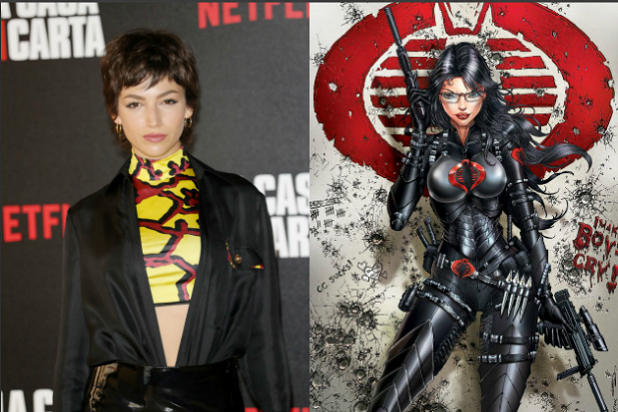 "Money Heist" breakout star Úrsula Corberó has closed a deal to play the Baroness in Paramount's "G.I. Joe" spinoff "Snake Eyes," an individual with knowledge of the deal exclusively told TheWrap. "Crazy Rich Asians" breakout Henry Golding is set to play Snake Eyes. "Warrior" headliner Andrew Koji is playing Storm Shadow. "Snake Eyes," the third live-action film based on the "G.I. Joe" toy line, will focus on the origins of the fan-favorite character known for his masked face, black commando uniform and ninja training. Robert Schwentke, the director of "Red" and "R.I.P.D.," is set to direct "Snake Eyes" for Paramount and Allspark Pictures, in association with Skydance. The film will be released on Oct. 16, 2020. Also Read: 'Crazy Rich Asians' Breakout Henry Golding in Talks to Play Snake Eyes in 'GI Joe' Movie Spinoff "Beauty and The Beast" screenwriter Evan Spiliotopoulos wrote the screenplay, and Lorenzo Di Bonaventura and Brian Goldner are producing. Jeff Waxman is executive producing. Hasbro, and Skydance are co-producing, while MGM is co-financing. The story centers on Snake Eyes' origins where he tries to become a member of the Arashikage Clan, a ninja clan based in Japan. According to "G.I. Joe vs. Cobra: The Essential Guide," the Arashikage worked as shadowy assassins for generations, using deception to earn their keep as ninjas, as well as developing a reputation for being able to perform impossible tasks. Corberó is best known for her roles in the television series "Fisica o Quimica," "Isabel," "La embajada" and "La casa de papel," which was acquired by Netflix in 2017 and was retitled "Money Heist." She also starred in films like "Paranormal Xperience 3D," and "El Arbol de La Sangre." Also Read: 'Snake Eyes': Andrew Koji to Play Storm Shadow in 'GI Joe' Movie Spinoff (Exclusive) She is represented by WME and Garay Talent. "G.I. Joe: The Rise of Cobra" grossed more than $300 million worldwide back in 2009 on a reported production budget of $175 million, not including prints and advertising. The 2013 sequel "G.I. Joe: Retaliation" starring Dwayne "The Rock" Johnson as Road Block grossed $375.7 million on a budget of $155 million. Channing Tatum, who played Duke in the first two films, was killed off early in "Retaliation" after complaining to Howard Stern how much he hated the role. Storm Shadow was previously played Byung-Hun Lee in "The Rise of Cobra" and "Retaliation."  |
| You are subscribed to email updates from "the portal movie" - Google News. To stop receiving these emails, you may unsubscribe now. | Email delivery powered by Google |
| Google, 1600 Amphitheatre Parkway, Mountain View, CA 94043, United States | |


Comments
Post a Comment